Showing posts with label family. Show all posts

Sunday, August 31, 2014

Little Failure by Gary Shteyngart


REVIEW

While reading the book I started writing the review as the memories of a young immigrant unfolded on the pages. I thought it was excellent, experienced, eloquent writing, gracing the valuable hours I spent reading it. 

Many hours it turned out to be, for I constantly fell asleep, due to the fact that I was either tired of working physically hard and very long hours for weeks now, or did not have time for a good sitting with the book, or the subject matter turned stale. I was not sure where the book was taking me.


One of my thoughts, while hanging in there was: How many books do we have to read about the lost generations of the drug-induced eras of the Sixties, Seventies, Eighties, Nineties into ad infinitum, and it's getting worse. What was once cult books for the enlightened and the ambitious social climbers, rebellion against an old order, petered out to become endless repeats of the same dark, morose hell of dopey thinking. Like old bread ...


Another thought was: I feel like Balaam's Ass, writing this review. I could treat this memoir as the scribbles of a nerdy, narcissistic Jewish friend, a needy, demanding one, or delve deeper into the Jewish comedy phenomenon and totally lose my way among the plethora of labels billowing all over the globe.


A third sleep-induced thought was : I was wondering why a youngish person, thirty-eight-years-old, would want to write a memoir, when his parents are still alive, and most of his adult life still pirouette on the horizon. It is, after all, a huge embarrassment to the family within their cultural context.

Then I thought about the title of the book and realized I probably would have done the same if my parents called me
"Little Failure" and I had enough shutzpah as well as eloquence, to revenge myself on them. My reaction to something like that , in my own humble scribbles, would have been "It takes one to know one!" Not that I think it was the intention in this tale. Mmm, perhaps it was! 


Beyond the often hilarious, witty tale, lies the image of, and I am borrowing the words of Ralph Ingesoll, ' an elephant being dressed in a hooped skirt and ruffled pants to make her look like a crinoline girl'


In one instance, as a young boy, he wrote a story, "Lenin and His Magical Goose" in which Lenin gets off his granite pedestal, gets onto the goose , flies over to Finland and bombard the 'hapless Fins' with the thick Soviet cheese. 


Like all satire and comedy, the author's masterful mockery of something unbearable is well hidden if the reader is naive enough not to understand this kind of satire. For those of us who admire and enjoy it, we understand the shudder, masked behind the slapstick, quick-witted jokes, with which the sad tale of the American- Jewish history is told. 


The intellectual quick-wit and laughter conceal the tragicomedy it really becomes. The underlying wealth of the tradition of Jewish comedy supports this tale. How can we forget people such as Jack Benny, the Marx Brothers, George Burns, Bette Midler, Woody Allen, Joan Rivers, Jerry Seinfeld , Billy Crystal, Adam Sandler and probably the world's most beloved comedian, Robin Williams? 


Comedians are extraordinary entertainers, provide an endless parade of gags, an unstoppable flow of jokes, and a unique slant on life and society. They provide audiences with a diversion, they retell history to lighten up the struggles of participating in the human condition; offer laughter in times of distress. 


The game of wit in this book is played superbly. The reader laughs at language, at unexpected turns of logic, at improbable situations. Laughter becomes a weapon to confront life's unfairness. 


There is a slight dollop of screwball zaniness flowing through the text as well, with Gary's loving, mismatched parents, as well as his own love experiences. His parents are constantly competing for his attention, constantly threaten each other with divorce, yet stay glued to the family unit for survival. 


He struggles to maintain his loyalty of all things Russian, the lessons his parents taught him, while trying to adapt to a new life in America, where the cultural blend is staggering. He also has to prove himself - a sickly asthmatic child with no friends- to his family and the outside world. 


This memoir tells the story of Igor Semyonovich Shteyngart (the disobedient son and beloved grandson, to his parents and grandmother Ploya); Gary Shteyngart ( to his teachers at the Solomon Schecter School of Queens); Yitzhak Ben Shimon, 'or some shit like that' ( to the Hebrew teachers); Gary Gnu The Third (to his fellow pupils with their Macy's regalia at Stuyvesant); and Shteyn-dawg to his university friends at Oberlin College, Ohio). The various personalities are also the various stages in his development with the behavioral patterns associated with it. 


Yet another memo to myself: The tone of the prose reminds me of 'Lucky Us' by Amy Bloom. I am unsure why. Perhaps it is the detailed descriptions, the struggle for survival, I don't know. Perhaps it is the fact that I just enjoyed reading both books. 


The humorous side of Little Failure' also places itself in the company of Giovanni Guareschi's Don Camillo tales. An element of Captain Corelli's Mandoline by Louis de Bernières is also present. First the blatent, in-your-face wit, and then the honest underscore of sadness and challenges waiting for the author and his family. 


However, the book is not about the Holocaust, neither the Soviet Communist regime's atrocities against its own people. This part of the author's history serves only as reference to the rest of their adaptation to American life. His parents were part of the 'Grain Jews' whose permission to immigrate was negotiated by Jimmy Carter in the 1970s. 


Gary eventually becomes a successful writer, despite the marriage détente of two mismatched people whom he calls his parents and the negative attention he constantly had to endure from them. 


It is evident that love comes in different forms, like a few regular slaps against the head, the silent treatments that drives him insane, and the constant reminders of his failures. But not grandmother Polya. Grandma Polya's love manifest itself in the daily three-hour gorging process after school.

"Behind every great Russian child, there is a Russian grandmother who act as chef de cuisine, bodyguard, personal shopper, and PR agent. You can see her in action in the quiet, leafy neighborhood of Rego Park, Queens, running after her thick-limbed grandson, with a dish of buckwheat, fruit, or farmer's cheese..."


I haven't read the author's other books. However, I can clearly understand why his previous books won various awards. Apart from becoming an insightful, compassionate author, he also became another loud voice of all 'late-comers' to the American dream; all the immigrants from all over the globe. 

In his quest to be accepted, to be loved, and to conquer his various aspirations, he ultimately becomes more American than the Americans themselves, just because he was trying too hard! He starts right at the beginning of being American, arriving as an immigrant in a country for immigrants, and excel through all the stages of settlement fairly quickly, where as it took most of the established Americans several generations to do the same. As he progresses and develops into the person he aims to be, his need, to associate with the known world of his culture and parents, becomes weaker. 


Memo: As a writer it can be his strongest or weakest point, depending on how far he is willing to venture off into new territory in his personal life and writing. 


Memo to self again: His evolution is typical of immigrants to a country. The first generation still honors the old country in culture and language, identifies with it strongly. The second generation will have lesser knowledge and desire to identify with the old teachings, will only use the original language at home, and the third generation can no longer speak the original language, nor have the need to be associated with the original culture. The future will tell. 


So in this sense, there is nothing new to this immigrant tale. What makes it different is the author's honest, direct approach to his own strengths and weaknesses and the sense of humor, the irony, the satire, he harnesses for his self-mockery. He is no angel at all. In fact, sometimes he is totally unlikable!


He summarizes his writing himself very well.

P. 277: "I'm desperately trying to have a history, a past. I am flooding myself with memory, melancholy and true. Every memory I repressed at the Solomon Schechter School of Queens, where I pretended to be a good East German, is coming back to me. I write about eating pelmenidumplings with my mother by the mermaid statue in Yalta. I write about the mechanical chicken I used to play with in the Crimea. About the girl with the one eye in our first apartment in America, the one who played Honeycomb license plates with me. I proudly use words I just picked up, words like "Aubusson", writing next to it, in parentheses, "French rug." I stick the Aubusson into a kind of literary action story called "Sundown at the International", complete with 'jet-black Sikorsky helicopters." 

Fifteen years later, that story will be expanded into the novel Absurdistan.

Sometimes my writing sucks, but sometimes it strives for the truth and it works. My parents are fighting across the pages. I am learning English. I am learning to be second-class. I am learning Adonai Eloheinu, Adonai Echad. Faced with an American pizza parlor, my "mother instructs me to order a pizza with meat on it so that I'll have a complete meal." My imagination is allowed to roam in all directions, even ones that fail (especially ones that fail). I hand in a truly strange character sketch of Nikita Khrushchev celebrating a lonely seventieth birthday on a collective farm. I write about my grandmother's fictional meeting with Pope John Paul II."
Refreshing, yes. Self-centered, for sure. It's a memoir.
" I knew I wanted to write a novel, and I knew what it would be about. When you're twenty-one there really is only one subject. It appears in the mirror each morning, toothbrush in hand."

In the end this book is not about revenge at all. It is an honest quest for understanding, for acceptance, and as a memoir, which ensures a stronger message, it is brilliantly done. In a memoir the truth can no longer be "an elephant being dressed in a hooped skirt and ruffled pants to make her look like a crinoline girl"

His friend John, who will help him develop his first novel, at one point told Gary what he could not see about himself in his writings:

"There is practically nothing writerly about your process. Your acute and omnipresent anxiety causes you to function much more as an accountant or a producer, with his eyes on the bottom line and no understanding of how artists function, rather than as as a young writer, trying to develop a first novel, a new career. In short, you are as mean and ungenerous to yourself as your parents are; they taught you well."

My final conclusion: This memoir is much more than just a colorful painting in which satire and irony was used as brushes. It's not only an intellectual, brilliant play with words. It's more than the sum total of a narcissistic brooding, or a self-pity partying memoir. 


In fact, I was sitting straight up, wide awake, when the ending unfolded. Yes, it was 3.30 in the morning. I gave up many hours of sleep to finish this book! 


How masterfully plotted! The Chesme Church on Moscow Square, introduces the author's memories to the reader, but surprisingly becomes the axes around which the memoir will return full circle and with good reason. There is even a touch of suspense created, which distinguish this memoir from any others I have read before. The young boy, then young man's struggle, apart from being an immigrant, could have been the story of all of us, if we can dish up the same guts to be THIS honest. In the end, it all came together and it was good. Very good indeed!


IN FACT, I RECOMMEND IT TO EVERYONE!


________________________________________________

BOOK BLURP
After three acclaimed novels—The Russian Debutante’s Handbook, Absurdistan, and Super Sad True Love Story—Gary Shteyngart turns to memoir in a candid, witty, deeply poignant account of his life so far. Shteyngart shares his American immigrant experience, moving back and forth through time and memory with self-deprecating humor, moving insights, and literary bravado. The result is a resonant story of family and belonging that feels epic and intimate and distinctly his own.

Born Igor Shteyngart in Leningrad during the twilight of the Soviet Union, the curious, diminutive, asthmatic boy grew up with a persistent sense of yearning—for food, for acceptance, for words—desires that would follow him into adulthood. At five, Igor decided to become a writer, and his grandmother paid him a slice of cheese for every page he produced. He wrote Lenin and His Magical Goose, his first novel.

In the late 1970s, world events changed Igor’s life. Jimmy Carter and Leonid Brezhnev made a deal: exchange tankers of grain for the safe passage of Soviet Jews to America—a country Igor viewed as the enemy. Along the way, Igor became Gary so that he would suffer one or two fewer beatings from other kids. Coming to the United States from the Soviet Union was equivalent to stumbling off a monochromatic cliff and landing in a pool of pure Technicolor.

Shteyngart’s loving but mismatched parents dreamed that he would become a lawyer or at least a “conscientious toiler” on Wall Street, something their distracted son was simply not cut out to do. Fusing English and Russian, his mother created the term Failurchka—Little Failure—which she applied to her son. With love. Mostly.

As a result, Shteyngart operated on a theory that he would fail at everything he tried. At being a writer, at being a boyfriend, and, most important, at being a worthwhile human being.

Swinging between a Soviet home life and American aspirations, Shteyngart found himself living in two contradictory worlds, all the while wishing that he could find a real home in one. And somebody to love him. And somebody to lend him sixty-nine cents for a McDonald’s hamburger.

Provocative, hilarious, and inventive, Little Failure reveals a deeper vein of emotion in Gary Shteyngart’s prose. It is a memoir of an immigrant family coming to America, as told by a lifelong misfit who forged from his imagination an essential literary voice and, against all odds, a place in the world.
________________________________________________

BOOK INFORMATION

Genres: Autobiography, Memoir, Russia, American immigrants, Family, New York, 
Solomon Schecter School of Queens, Oberlin, Ohio, Stuyvesant School, Grain Jews

Formats: Hard cover , Paperback, Kindle,
Number of Pages: 351
Publisher: Penguin(USA)  Hamish Hamilton (UK) 
Publication date: February 27th, 2014
Language: English
ISBN-10: 0241146658
ISBN-13: 978-0241146651
ASIN: B00H7O86W6

Purchase links:  Amazon USA | Amazon UK | Loot.co.za


_________________________________________________

ABOUT THE AUTHOR

Photo credit

Gary Shteyngart was born in Leningrad in 1972 and came to the United States seven years later. His debut novel, The Russian Debutante's Handbook, won the Stephen Crane Award for First Fiction and the National Jewish Book Award for Fiction. His second novel, Absurdistan, was named one of the 10 Best Books of the Year by The New York Times Book Review, as well as a best book of the year by Time, The Washington Post Book World, the San Francisco Chronicle, the Chicago Tribune, and many other publications. He has been selected as one of Granta's Best Young American Novelists. His work has appeared in The New Yorker, Esquire, GQ, and Travel + Leisure and his books have been translated into more than twenty languages. He lives in New York City. (Info Source)

________________________________________________


Tuesday, May 20, 2014

October by Zoe Wicomb


MY REVIEW
Scotland / South Africa.
I am not sure if this book is more biography than fiction or the other way around. There are many similarities between the protagonist's and the author's lives. As I am not sure what is fact and what is fiction, I will review it as a fictitious tale.

Mercy, or Mercia, is an English senior lecturer at a Scottish university. She left South Africa in the early Seventies to settle overseas after deciding to make a new life for herself away from the political-discriminatory establishment, as well as her personal family situation. After many years her father dies and her brother, a totally and too-far-gone alcoholic, writes her a letter and pleads with her to return home.

Her life partner, a Scottish poet, has just decided to leave her after many years of sharing a life outside marriage with no children born from the relationship. She never wanted children and regards herself as a feminist.

To clear up her own emotional turmoil, as well as life, she decides to take a break and return to the dusty, semi-arid village in the Namaqualand region for a holiday, where she grew up with her brother, taken care of by their father after their mother died many years earlier. What she encounters there, the poverty, the desperation, the neglect, as well as the intelligent ignored little boy(her brother's son), shocks and depresses her. Her brother pleads with her to take the child.

The tiresome, slow moving narrative provides an in-depth look into the life of the brother and sister; their bitter relationship with their abusive father; the situation in which the little boy was born; her 'snobbish' attitude towards her sister-in-law; her broken love affair with her ex-life partner and her confusion with her true identity. 

After coming back and being suddenly thrust back into her past with all the emotions around the political as well as social memories of their world brought to life once again,she expects to feel the same as when she left, but too many changes occurred and the new experiences of her old world turns everything she held dearly as the truth upside down. What began as a social visit turned into a challenge in which she must navigate a new life for herself from it all. The little boy becomes a catalyst for the memories she kept locked away deep inside her. His innocence and trust in her unraffels the feelings of apathy and emotional arrest she so dearly cultivated to protect herself against a cruel South African political system and a new reality in Scotland which redefined her. 

When she is finally ready for an emotional as well as geographical turning point, sure of her new direction, a family secret destroys everything she ever held sacred. She had to become a middle-aged woman before she finally could face her true reality. There is a heritage she cannot escape, responsibilities she never wanted, consequences to the choices she made. 

The scenery in the book is excellently described. The protagonist's feelings are laid bare and dissected. For both international, as well as South African readers, the story will be both enchanting but equally heartbreaking. The Afrikaans words which is not explained in the narrative can easily be translated online. There are not too many of them. The words also do not interrupt the overall story and how everyone's life is interconnected with each other and nature. A fascinating experience!

There is such a wealth of emotions exposed in the book, so much human nature to discover as the reader becomes intimately involved with the characters as they develop and provide more colour and texture to the story. The reader is left with an insight into a multilayered true South African experience. Or rather, a glimpse into the world of a Colored family in a remote part of the country. It is not everyone's story. But it is an important as well as endearing one to share. I felt infinitely enriched by this book.

________________________________________________

BOOK BLURB
“Mercia Murray is a woman of fifty-two years who has been left.” Abandoned by her partner in Scotland, where she has been living for twenty-five years, Mercia returns to her homeland of South Africa to find her family overwhelmed by alcoholism and secrets. Poised between her life in Scotland and her life in South Africa, she recollects the past with a keen sense of irony as she searches for some idea of home. In Scotland, her life feels unfamiliar; her apartment sits empty. In South Africa, her only brother is a shell of his former self, pushing her away. And yet in both places she is needed, if only she could understand what for. Plumbing the emotional limbo of a woman who is isolated and torn from her roots, October is a stark and utterly compelling novel about the contemporary experience of an intelligent immigrant, adrift among her memories and facing an uncertain middle age.

With this pitch-perfect story, the “writer of rare brilliance” (The Scotsman) Zoë Wicomb—who received one of the first Donald Windham–Sandy M. Campbell Literature Prizes for lifetime achievement—stands to claim her rightful place as one of the preeminent contemporary voices in international fiction.

________________________________________________

ABOUT THE AUTHOR
Zoë Wicomb  was born in Namaqualand and attended the University of the Western Cape. After graduating, she left South Africa for England in 1970, where she continued her studies at Reading University. She lived in Nottingham and Glasgow and returned to South Africa in 1990, where she taught for three years in the department of English at the University of the Western Cape She gained attention in South Africa and internationally with her first work, a collection of short stories , You Can't Get Lost in Cape Town (1987), which takes place during the apartheid era. Her second novel, David's Story (2002), takes place in 1991 toward the close of the apartheid era and uses the ambiguous classification of coloureds to explore racial identity. Playing in the Light, her third novel, released in 2006, covers similar terrain conceptually, though this time set in contemporary South Africa and centering around a white woman who learns that her parents were actually coloured. She published her second collection of short stories, The One That Got Away. The stories, set mainly in Cape Town and Glasgow, explore a range of human relationships: marriage, friendships, family ties or relations with servants.

She was a winner of the 2013 Windham–Campbell Literature Prize for Fiction.

Zoe Wicomb resides in Glasgow where she teaches creative writing and post-colonial literature at the University of Strathclyde.

________________________________________________

BOOK INFORMATION
Genres : Scotland, South Africa, Namaqualand, Family, Drama, Literature
Formats: Hard cover , Audible
Number of Pages: 256
Publisher: New Press, The 
Publication date: March 4, 2014
Language: English
ISBN-10: 1595589627
ISBN-13: 978-1595589620
Purchase links:  Amazon USA | Amazon UK | Barnes & Noble


Thursday, October 24, 2013

The Embers of Heaven by Alma Alexander (Jin-Shei #2)

 Kindle edition
Paperback


Genre: Chinese Historical fantasy, Drama, Family, Relationships, 
Pages: 480 pages
Formats: Paperback(2nd Hand perhaps as well) Kindle, Nook

Published:  July 1st 2009
Publisher:   
 Harper Collins (first published January 1st 2006)
Original title: The Embers of Heaven
ISBN:  0007204078 (ISBN13: 9780007204076)
Edition language: English

Series: Jin-Shei #2
Purchase links: Amazon; Barnes & Noble


Amazon Book Blurb:
The International Bestselling Sequel to The Secrets of Jin-shei

Four hundred years after The Secrets of Jin-shei, the Syai Empire is on the brink of civil war. A new voice preaching equality promises hope for the downtrodden, but the ensuing people’s revolution brings terror, reeducation camps, and death to anyone embracing the old ways.

An outsider and a child of two worlds, Amais searches for the magical bond of jin-shei, the women’s oath, in her ancestral home of Syai, unaware that her quest will bring her to the very person who may destroy her and her family. And yet, she must face him, or all hope for Syai will be lost…

“Beautifully written, with rich characterisation and captivating originality, it quickly draws you in and is a real page-turner.” -- Glasgow Evening Times

“The Last Samurai has nothing on this complex adventure.” Belfast Telegraph

"A beautiful and magical tale of one girl's quest to restore the secret language of jin-shei and its customs to Syai four hundred years on from its peak. Amais finds her crusade swept up in a people's revolution which threatens her bid to restore the once powerful sisterhood. Richly layered with a strong sense of place and wonderfully written characters. Perfect if you enjoyed Memoirs of a Geisha." -- Lovereading.co.UK


REVIEW:
This review is an addition to the GR book blurb.

Amais, a little girl, was torn between two families. On the one hand there was her maternal grandmother who tutored her in the ancient women's language, jin-ashu - the language of gentle things, of her royal ancestors, insisting on it being done. On the other hand there was Amais's dad, a commoner and fisherman, who taught her the secrets of the sea, introducing her to the dolphins in a cove - his secret place of rendezvous with these gentle creatures of the sea. But then he died.

Her mother decided to take her two daughters and go back to the land of her ancestors, Syai, amid a bitter battle between herself and her mother-in-law, Elena. Apart from this power struggle, both grandmothers staked their claims on the two granddaughters of which Amais was the oldest. Nika, the youngest, born the day her dad drowned in his fishing boat, was regarded as the incarnation of her dad, the son of Elena, and deepened the rift between the two grandmothers from different social classes. Nika had two names due to the grandmothers insisting on naming the child. For Elena she was Nika, and for Dan, Aylun. For Vian it became intolerable to be caught up in the middle with her two daughters.

For nine-year-old Amais the sea voyage between Elaas, her place of birth, and Syai, the place of her ancestors, will be the place where her past and future will be lost and born.

However, Amais would find a deeper mission by way of her dreams in which her ancestors would guide her to reach her real destiny. She inherited the ancient journals of an maternal ancestor which she promised to protect forever. It contained the secrets of a women-bond written in a language only the women could understand.

The second main character is Iloh - the peasant boy, who would achieve every dream he ever dreamed and much more. His past and his future were not the same thing and he did not care what was behind or what the consequences of today would be on tomorrow. Iloh's story is loosely (although historically quite accurate) based on the life of Mao Tse-tung, who was born on 26th December 1893, in a valley called Shaoshan, in the province of Hunan, in the heartland of China. This region was dotted with beautiful, ancient Buddhist temples. It was surrounded by forests where more than 300 species of trees grew in abundance, and was protected by the isolating hills. Although it is not mentioned in the book, these surroundings are accurately borrowed for this tale. It will become one of the main backgrounds in the book.

This is a historical fantasy, which is confusing in itself, since too much accurate historical facts form the background to the story. Taken as a historical fantasy it is a good book and very well written in beautiful prose. I was drawn into the story from round about page 90 and continued mesmerized for most of it. But since I read the books of Amy Tan, Wild Swans-Three Daughters of China, and Mao - The Unknown Story, I was able to recognize the historical facts offered in the fictional tale. I also read books before of Lisa See and Amy Tan, with which I compared this book and found The Embers of Heaven to be a successful assimilation of the two approaches. Amy Tan and Jung Chang dish out the hard 
cold facts on the one side, and Lisa See presents a much softer romantic coloring of the history and culture on the other. However, in certain respects this story was just too fantastical for my taste. I still cannot figure out why it was suggested as a historical fantasy. Historical fiction could have worked very well. However, it is always a risk to write about a country as a foreigner and bend the historical facts a bit to fit a plot. So it makes sense then to offer it as a fantasy.

The elements in the book blended well. The descriptions were breathtaking. The plot was convincing.

I really would love to rate it five stars, since so much research went into the book and it was very well written.

What I did not like: I would have loved to read more detail about the food that was eaten; the specific medicines used. For instance, during Amais's stay in the temple, she mentioned the vegetable stew. I was wondering: what exactly was in the stew, how was it prepared. In various places in the book I wanted more detail of the mundane things. To a certain extent this lack of small details rendered the story light-weight, although it is in reality a detailed, multifaceted book. The story was dragged out with too much information added through the dreams and thoughts that was included, and became a marathon reading to finish in the end. The drama got lost as a result in the middle part of the book, but not in the entire story. However, I needed a huge second breath to finish. It took a little bit of self-convincing to do so, which is a pity. It is a strong, powerful story and a book I will read again in ten years time. Yes, it is one of those stories that will stay with me for a very long time! It was a really relaxing, interesting, good read.


ABOUT THE AUTHOR:

"I have a wonderful occupation; I dream for a living." Alma Alexander
----- ------ ----- ----- -----
Alma Alexander, the 'Duchess of Fantasy,' was born on the banks of an ancient river in a country which no longer exists. When she was ten, her family left Europe and moved to Africa. Since then she has lived in several countries on four continents and now lives in America with a husband she met on the Internet
She has written three million words in more than 20 books and one of her novels, "The Secrets of Jin-shei," has been published around the world in 14 languages. The heroine of her popular Young Adult Worldweavers series is as American as Harry Potter is British. The first book in another young adult series about a shape-shifting Were family will be published shortly.
When asked what she would be if she weren't a writer, she quotes Ursula LeGuin's answer to that question: "Dead."
Alma is a punaholic and a chronic worrier, one of those people who proves that real pessimists are truly born and not made. She is owned by a cat. She was born on the fifth day of July (the day after America), six years before man walked on the moon, which makes her a cancer according to the Western horoscope and a water rabbit according to the Chinese one.
(Information source: Amazon)

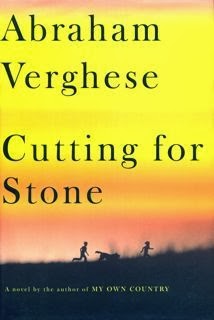
Cutting for Stone by Abraham Verghese


Genre: Africa, Drama, Family, Fiction, Relationships, Thriller, Suspense, 

Formats: Ebook, Kindle, Nook, Paperback, Hardcover, Audiobook, CD,
Publishers: Knopf
Published date:  February 3rd, 2009
ISBN: 0375414495 (ISBN13: 9780375414497)
Pages: 541
Edition language: English
Literary awards: Exclusive Books Boeke Prize Nominee (2011), Indies Choice Book Award for Adult Fiction (2010), PEN/Hemingway Foundation Award Finalist (2010), Goodreads Choice Nominee for Fiction (2009)Purchase linksAmazon,    Barnes & Noble


Amazon Book Blurb:
A sweeping, emotionally riveting first novel—an enthralling family saga of Africa and America, doctors and patients, exile and home.

Marion and Shiva Stone are twin brothers born of a secret union between a beautiful Indian nun and a brash British surgeon at a mission hospital in Addis Ababa. Orphaned by their mother’s death in childbirth and their father’s disappearance, bound together by a preternatural connection and a shared fascination with medicine, the twins come of age as Ethiopia hovers on the brink of revolution. Yet it will be love, not politics—their passion for the same woman—that will tear them apart and force Marion, fresh out of medical school, to flee his homeland. He makes his way to America, finding refuge in his work as an intern at an underfunded, overcrowded New York City hospital. When the past catches up to him—nearly destroying him—Marion must entrust his life to the two men he thought he trusted least in the world: the surgeon father who abandoned him and the brother who betrayed him.

An unforgettable journey into one man’s remarkable life, and an epic story about the power, intimacy, and curious beauty of the work of healing others.


REVIEW:
Addis Ababa - Ethiopia; Madras - India; New York & Boston -USA.

Before you read this book, consider this: the book was printed with an average of 425 words per page for 541 pages in an almost minus zero font size. That jerked my chain a bit, so I did not begin reading this book in quite the right frame of mind. 

But who in their right mind would like to put down a book beginning like this:

"My brother, Shiva, and I came into the world in the late afternoon of the twentieth of September in the year of Grace 1954. We took our first breath in the thin air, 8 000 feet above sea level, of the capital city of Ethiopia, Addis Ababa."

"Bound by birth, we were driven apart by bitter betrayal. No surgeon can heal the wound that divides two brothers. Where silk and steel fail, story must succeed."
The twins, Drs. Marion , and Shiva Praise Stone, were born to a nun, Sister Mary Joseph Praise from the Carmalite Order of Madras, who were sent with Sister Anjali to darkest Africa to serve in hospitals. She would end up at the "Missing"(Mission) hospital of Addis Ababa, Ethiopia, via Aden in Yemen, with a dark secret she cold never share.
"Sister Mary Joseph was a Malayali Christian. She could trace her faith back to St. Thomas's arrival in India from Damascus in A.D. 52. "Doubting" Thomas built his first churches in Karala well before St. Peter got to Rome."

"To her parents' chagrin, my mother became a Carmalite none,abandoning the ancient Syrian Christian tradition of St. Thomas to embrace (in her parents view) this Johnny-come-lately, pope-worshipping sect... It was a good thing her parents didn't know that she was also a nurse, which to them would mean that she soiled her hands like an untouchable."
In the first 109 pages the background to the birth is introduced and when the birth finally takes place with high drama, I sighed with relief. Pardon my momental snarkyness, but I almost put down the book and moved on. 

At first the book did not tickle my cor musculi really, it often rather annoyed the Musculus sphincter ani internus instead! The good thing was that the book distinctly distinguished itself from a romance novel by allocating 109 pages to the birth of the twins instead of to coitus, although it did challenge my knowledge of Latin and anatomy to the extreme. The good thing about romance novels is that they do not use Latin a thousand times to breath, whisper, huff, puff, holler and cry, "I Love You." 

This book did not do it either, thank goodness, but I was holding my breath! With the intensity and detail the characters' lives, especially those of the twins, were initially colored in with Latin so lavishly splashed all over it, anything was possible! And everything pointed to a great love story in the making after all!

Yes, I was equally as impressed as I was slightly blowing steam off through my nares by being constantly dropped into the world of Latin by a surgeon (Dr.Thomas Stone) whose work was his life hiding his "social retardiness" - as expressed by his colleagues. I did not want to read a medical journal at all ! 

The love of Latin genetically moves forward to the next generation. Marion would as a young boy discover the magic:

"I loved those Latin words for their dignity, their foreigness and that my tongue had to wrap around them. I felt that in learning the special language of a scholarly order, I was amassing a kind of force. This was the poor and noble side of the world, uncorrupted by secrets and trickery."
Dr. Gosh was of the opinion that the language of love and medicine was the same "Take off your shirt. Open your mouth. Take a deep breath.".

The surgeon, Dr. Thomas Stone, would have disagreed. He would have insisted on Latin near, or on, any bed! That's all he really understood. And this is where I almost gave up on the book, not because it was not well written - it was in fact brilliantly prosed from the start, but because it seemed as though I needed to order a Latin dictionary first and do at least six years of medical school before I could proceed and I was just not in the mood for it! If the storyline was to be taken away, it could have been a well-texted book on practicing medicine in the tropics.

As a young boy, Marion would receive his first stethoscope from Dr.Gosh. Was there more in this gift than the eyes could see? Was he trying to teach this boy how to find the secrets behind his parents and he and his brother's birth? :

"He invited me into a world that was not secret, but it was well hidden. You needed a guide. You had to know what to look for, but also how to look. You had to exert yourself to see this world. But if you did, if you had that kind of curiosity, if you had an innate interest in the welfare of your fellow human beings, and if you went through that door, a strange thing happened: you left your petty troubles on the threshold. It could be addictive."
It is exactly the reason why I just could not put the bloody book down, for, believe me, bloody it was! Buckets full of it!

The narrative focuses mostly on the lives of the two twins in their growing up years and which events and people would structure their characters / personalities / destinies. In the end the expression comes to mind: "It is not what happens to you, but how you handle it, that counts."

The tale is an intense, well-researched, well-written novel introducing the fascinating societies of Addis Ababa - Ethopia, Madras - India, New York & Boston in the USA. The book blends African politics, people, compassion, love, fast paced adventure and fiction in such a way that all readers from all walks of life, especially hospital-story junkies, interested in this beautiful but harsh African continent, will find some aspect of the book agreeable and worth reading. 

One of my favorite Mark Twain aphorisms is: "I can live for two months on a good compliment."

For me it is not a compliment but strings of words having me wonder around in sheer delirious bliss! Abraham Verghese rooted me to the book with prose like this:

"There was three spaced knocks on the door of Matron's office. "Come in," Matron said,and with those words Missing was on a course different than anyone could have imagined. It was at the start of the rainy season, when Addis was stunned into wet submission."
There are sweet anecdotal moments such as this: Dr. Marion Praise Stone, the narrator, recounts a moment in their childhood:
"In our household, you had to dive into the din and push to the front if you wanted to be heard. The foghorn voice was Ghosh's, echoing and tailing off into laughter. Hema was the songbird, but when provoked her voice was as sharp as Saladin's scimitar,which, according to my Richard the Lion Hearted and the Crusades, could divide a silk scarf allowed to float down onto the blade's edge. Almaz, our cook, may have been silent on the outside, but her lips moved constantly, whether in prayer or song,no one knew. Rosina took silence as a personal offense, and spoke into empty rooms and chattered into cupboards. Genet, almost six years old of age, was showing signs of taking after her mother, telling herself stories about herself in a singsong voice, creating her own mythology."
Initially there is a deceitful tranquility present in the rhythm of the prose. The author used an ingenious method to pacify the reader while having an addictive mixture of tension and drama bubbling and boiling underneath. 

Marion never wanted to sit in the twin-stroller playing with his wooden truck like his brother. Marion wanted an adult view on the world. Rosina had to constantly carry him around. 

The epiphany, for me, happened here:

P.184: "...the kitchen was alive. Steam rises in plumes as Almaz clangs lids on and off the pots. The silver weight on the pressure cooker jiggles and whistles. Almaze's sure hands chop onions, tomatoes, and fresh coriander, making hillocks that dwarf the tiny mounds of ginger and garlic. ... A mad alchemist she throws a pinch of this, a fistful of that, then wets her fingers and flings that moisture into the mortar. She pounds with the pestle, the wet, crunchy thunk thunk soon changes to the sound of stone on stone.

...Mustard seeds explode in the hot oil. She holds a lid over the pan to fend off the missiles. Rat-a-tat! like hail on the tin roof. She adds the cumin seeds, which sizzles, darken and crackle. A dry, fragrant smoke chases out the mustard scent. Only then are the onions added, handfuls of them, and now the sound is that of life being spawned in a primordial fire.

Rosina abruptly hands me over to Almaz... I whimper on Almaz's shoulder, perilously close to the bubbling cauldrons. Almaz puts down the laddle and shifts me to her hip. Reaching into her blouse, grunting with effort, she fishes out her breast.

"Here it is," she says, putting it in my hands for safekeeping...Almaz, who hardly speaks, resumes stirring, humming a tune. It is as if the breast no more belongs to her than does the laddle.
"
This scene above acted as a metaphor for this book: so seemingly uncomplicated, innocent and serene on the surface, but exploding with energy under the lid! What was hidden in the mixture would ultimately add meaning and definition, like exquisite aromas from a pot-pourri of herbs and spices to the people's lives. The experience will be hot and penetrating; sweet and scrumptious, heavy and often "indigestably" cruel.

From then on things started to happen rapidly, the drama increased leaving the reader mesmerized and in complete wonder!

The story was brilliantly constructed, although it could have been a 100 pages shorter, in my opinion. There were almost an endless role of "Latin-ish"-like hospital scenes that leaves the impression of the author expressing opinions through a novel instead of getting his ideas published elsewhere. I was surprised, when thinking back on the role of each person in the narrative, how each one of them made an amazing contribution to the story! The characters was well developed; the denouement at the end of all the elements a huge surprise. The story completes a full unbelievable circle, which really had me sitting back in total amazement. The end left me breathless....and yes speechless...! And when I started recounting all the elements in the book I was amazed at the unusual brilliant tale it was.

A Great read!


ABOUT THE AUTHOR:


Abraham Verghese, MD, MACP, is Professor for the Theory and Practice of Medicine at the Stanford University School of Medicine and Senior Associate Chair of the Department of Internal Medicine.

Born of Indian parents who were teachers in Ethiopia, he grew up near Addis Ababa and began his medical training there. When Emperor Haile Selassie was deposed, he completed his training at Madras Medical College and went to the United States for his residency as one of many foreign medical graduates. Like many others, he found only the less popular hospitals and communities open to him, an experience he described in one of his early New Yorker articles, The Cowpath to America.

From Johnson City, Tennessee, where he was a resident from 1980 to 1983, he did his fellowship at Boston University School of Medicine, working at Boston City Hospital for two years. It was here that he first saw the early signs of the HIV epidemic and later, when he returned to Johnson City as an assistant professor of medicine, he saw the second epidemic, rural AIDS, and his life took the turn for which he is most well known - his caring for numerous AIDS patients in an era when little could be done and helping them through their early and painful deaths was often the most a physician could do.

His work with terminal patients and the insights he gained from the deep relationships he formed and the suffering he saw were intensely transformative; they became the basis for his first book, My Own Country : A Doctor's Story, written later during his years in El Paso, Texas. Such was his interest in writing that he decided to take some time away from medicine to study at the Iowa Writers Workshop at the University of Iowa, where he earned a Master of Fine Arts degree in 1991. Since then, his writing has appeared in The New Yorker, Texas Monthly, Atlantic, The New York Times, The New York Times Magazine, Granta, Forbes.com, and The Wall Street Journal, among others.

Following Iowa, he became professor of medicine and chief of the Division of Infectious Diseases at Texas Tech Health Sciences Center in El Paso, Texas, where he lived for the next 11 years. In addition to writing his first book, which was one of five chosen as Best Book of the Year by Time magazine and later made into a Mira Nair movie, he also wrote a second best-selling book, The Tennis Partner : A Story of Friendship and Loss, about his friend and tennis partner's struggle with addiction. This was a New York Times' Notable Book.