
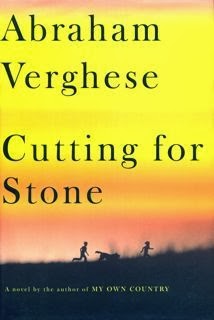
Genre: Africa, Drama, Family, Fiction, Relationships, Thriller, Suspense,
Formats: Ebook, Kindle, Nook, Paperback, Hardcover, Audiobook, CD,
Publishers: Knopf
Published date: February 3rd, 2009
ISBN: 0375414495 (ISBN13: 9780375414497)
Pages: 541
Edition language: English
Publishers: Knopf
Published date: February 3rd, 2009
ISBN: 0375414495 (ISBN13: 9780375414497)
Pages: 541
Edition language: English
Literary awards: Exclusive Books Boeke Prize Nominee (2011), Indies Choice Book Award for Adult Fiction (2010), PEN/Hemingway Foundation Award Finalist (2010), Goodreads Choice Nominee for Fiction (2009)Purchase links: Amazon, Barnes & Noble
Amazon Book Blurb:
Marion and Shiva Stone are twin brothers born of a secret union between a beautiful Indian nun and a brash British surgeon at a mission hospital in Addis Ababa. Orphaned by their mother’s death in childbirth and their father’s disappearance, bound together by a preternatural connection and a shared fascination with medicine, the twins come of age as Ethiopia hovers on the brink of revolution. Yet it will be love, not politics—their passion for the same woman—that will tear them apart and force Marion, fresh out of medical school, to flee his homeland. He makes his way to America, finding refuge in his work as an intern at an underfunded, overcrowded New York City hospital. When the past catches up to him—nearly destroying him—Marion must entrust his life to the two men he thought he trusted least in the world: the surgeon father who abandoned him and the brother who betrayed him.
An unforgettable journey into one man’s remarkable life, and an epic story about the power, intimacy, and curious beauty of the work of healing others.
REVIEW:
Before you read this book, consider this: the book was printed with an average of 425 words per page for 541 pages in an almost minus zero font size. That jerked my chain a bit, so I did not begin reading this book in quite the right frame of mind.
But who in their right mind would like to put down a book beginning like this:
"My brother, Shiva, and I came into the world in the late afternoon of the twentieth of September in the year of Grace 1954. We took our first breath in the thin air, 8 000 feet above sea level, of the capital city of Ethiopia, Addis Ababa."The twins, Drs. Marion , and Shiva Praise Stone, were born to a nun, Sister Mary Joseph Praise from the Carmalite Order of Madras, who were sent with Sister Anjali to darkest Africa to serve in hospitals. She would end up at the "Missing"(Mission) hospital of Addis Ababa, Ethiopia, via Aden in Yemen, with a dark secret she cold never share.
"Bound by birth, we were driven apart by bitter betrayal. No surgeon can heal the wound that divides two brothers. Where silk and steel fail, story must succeed."
"Sister Mary Joseph was a Malayali Christian. She could trace her faith back to St. Thomas's arrival in India from Damascus in A.D. 52. "Doubting" Thomas built his first churches in Karala well before St. Peter got to Rome."In the first 109 pages the background to the birth is introduced and when the birth finally takes place with high drama, I sighed with relief. Pardon my momental snarkyness, but I almost put down the book and moved on.
"To her parents' chagrin, my mother became a Carmalite none,abandoning the ancient Syrian Christian tradition of St. Thomas to embrace (in her parents view) this Johnny-come-lately, pope-worshipping sect... It was a good thing her parents didn't know that she was also a nurse, which to them would mean that she soiled her hands like an untouchable."
At first the book did not tickle my cor musculi really, it often rather annoyed the Musculus sphincter ani internus instead! The good thing was that the book distinctly distinguished itself from a romance novel by allocating 109 pages to the birth of the twins instead of to coitus, although it did challenge my knowledge of Latin and anatomy to the extreme. The good thing about romance novels is that they do not use Latin a thousand times to breath, whisper, huff, puff, holler and cry, "I Love You."
This book did not do it either, thank goodness, but I was holding my breath! With the intensity and detail the characters' lives, especially those of the twins, were initially colored in with Latin so lavishly splashed all over it, anything was possible! And everything pointed to a great love story in the making after all!
Yes, I was equally as impressed as I was slightly blowing steam off through my nares by being constantly dropped into the world of Latin by a surgeon (Dr.Thomas Stone) whose work was his life hiding his "social retardiness" - as expressed by his colleagues. I did not want to read a medical journal at all !
The love of Latin genetically moves forward to the next generation. Marion would as a young boy discover the magic:
"I loved those Latin words for their dignity, their foreigness and that my tongue had to wrap around them. I felt that in learning the special language of a scholarly order, I was amassing a kind of force. This was the poor and noble side of the world, uncorrupted by secrets and trickery."Dr. Gosh was of the opinion that the language of love and medicine was the same "Take off your shirt. Open your mouth. Take a deep breath.".
The surgeon, Dr. Thomas Stone, would have disagreed. He would have insisted on Latin near, or on, any bed! That's all he really understood. And this is where I almost gave up on the book, not because it was not well written - it was in fact brilliantly prosed from the start, but because it seemed as though I needed to order a Latin dictionary first and do at least six years of medical school before I could proceed and I was just not in the mood for it! If the storyline was to be taken away, it could have been a well-texted book on practicing medicine in the tropics.
As a young boy, Marion would receive his first stethoscope from Dr.Gosh. Was there more in this gift than the eyes could see? Was he trying to teach this boy how to find the secrets behind his parents and he and his brother's birth? :
"He invited me into a world that was not secret, but it was well hidden. You needed a guide. You had to know what to look for, but also how to look. You had to exert yourself to see this world. But if you did, if you had that kind of curiosity, if you had an innate interest in the welfare of your fellow human beings, and if you went through that door, a strange thing happened: you left your petty troubles on the threshold. It could be addictive."It is exactly the reason why I just could not put the bloody book down, for, believe me, bloody it was! Buckets full of it!
The narrative focuses mostly on the lives of the two twins in their growing up years and which events and people would structure their characters / personalities / destinies. In the end the expression comes to mind: "It is not what happens to you, but how you handle it, that counts."
The tale is an intense, well-researched, well-written novel introducing the fascinating societies of Addis Ababa - Ethopia, Madras - India, New York & Boston in the USA. The book blends African politics, people, compassion, love, fast paced adventure and fiction in such a way that all readers from all walks of life, especially hospital-story junkies, interested in this beautiful but harsh African continent, will find some aspect of the book agreeable and worth reading.
One of my favorite Mark Twain aphorisms is: "I can live for two months on a good compliment."
For me it is not a compliment but strings of words having me wonder around in sheer delirious bliss! Abraham Verghese rooted me to the book with prose like this:
"There was three spaced knocks on the door of Matron's office. "Come in," Matron said,and with those words Missing was on a course different than anyone could have imagined. It was at the start of the rainy season, when Addis was stunned into wet submission."There are sweet anecdotal moments such as this: Dr. Marion Praise Stone, the narrator, recounts a moment in their childhood:
"In our household, you had to dive into the din and push to the front if you wanted to be heard. The foghorn voice was Ghosh's, echoing and tailing off into laughter. Hema was the songbird, but when provoked her voice was as sharp as Saladin's scimitar,which, according to my Richard the Lion Hearted and the Crusades, could divide a silk scarf allowed to float down onto the blade's edge. Almaz, our cook, may have been silent on the outside, but her lips moved constantly, whether in prayer or song,no one knew. Rosina took silence as a personal offense, and spoke into empty rooms and chattered into cupboards. Genet, almost six years old of age, was showing signs of taking after her mother, telling herself stories about herself in a singsong voice, creating her own mythology."Initially there is a deceitful tranquility present in the rhythm of the prose. The author used an ingenious method to pacify the reader while having an addictive mixture of tension and drama bubbling and boiling underneath.
Marion never wanted to sit in the twin-stroller playing with his wooden truck like his brother. Marion wanted an adult view on the world. Rosina had to constantly carry him around.
The epiphany, for me, happened here:
P.184: "...the kitchen was alive. Steam rises in plumes as Almaz clangs lids on and off the pots. The silver weight on the pressure cooker jiggles and whistles. Almaze's sure hands chop onions, tomatoes, and fresh coriander, making hillocks that dwarf the tiny mounds of ginger and garlic. ... A mad alchemist she throws a pinch of this, a fistful of that, then wets her fingers and flings that moisture into the mortar. She pounds with the pestle, the wet, crunchy thunk thunk soon changes to the sound of stone on stone.This scene above acted as a metaphor for this book: so seemingly uncomplicated, innocent and serene on the surface, but exploding with energy under the lid! What was hidden in the mixture would ultimately add meaning and definition, like exquisite aromas from a pot-pourri of herbs and spices to the people's lives. The experience will be hot and penetrating; sweet and scrumptious, heavy and often "indigestably" cruel.
...Mustard seeds explode in the hot oil. She holds a lid over the pan to fend off the missiles. Rat-a-tat! like hail on the tin roof. She adds the cumin seeds, which sizzles, darken and crackle. A dry, fragrant smoke chases out the mustard scent. Only then are the onions added, handfuls of them, and now the sound is that of life being spawned in a primordial fire.
Rosina abruptly hands me over to Almaz... I whimper on Almaz's shoulder, perilously close to the bubbling cauldrons. Almaz puts down the laddle and shifts me to her hip. Reaching into her blouse, grunting with effort, she fishes out her breast.
"Here it is," she says, putting it in my hands for safekeeping...Almaz, who hardly speaks, resumes stirring, humming a tune. It is as if the breast no more belongs to her than does the laddle."
From then on things started to happen rapidly, the drama increased leaving the reader mesmerized and in complete wonder!
The story was brilliantly constructed, although it could have been a 100 pages shorter, in my opinion. There were almost an endless role of "Latin-ish"-like hospital scenes that leaves the impression of the author expressing opinions through a novel instead of getting his ideas published elsewhere. I was surprised, when thinking back on the role of each person in the narrative, how each one of them made an amazing contribution to the story! The characters was well developed; the denouement at the end of all the elements a huge surprise. The story completes a full unbelievable circle, which really had me sitting back in total amazement. The end left me breathless....and yes speechless...! And when I started recounting all the elements in the book I was amazed at the unusual brilliant tale it was.
A Great read!

ABOUT THE AUTHOR:

Abraham Verghese, MD, MACP, is Professor for the Theory and Practice of Medicine at the Stanford University School of Medicine and Senior Associate Chair of the Department of Internal Medicine.
Born of Indian parents who were teachers in Ethiopia, he grew up near Addis Ababa and began his medical training there. When Emperor Haile Selassie was deposed, he completed his training at Madras Medical College and went to the United States for his residency as one of many foreign medical graduates. Like many others, he found only the less popular hospitals and communities open to him, an experience he described in one of his early New Yorker articles, The Cowpath to America.
From Johnson City, Tennessee, where he was a resident from 1980 to 1983, he did his fellowship at Boston University School of Medicine, working at Boston City Hospital for two years. It was here that he first saw the early signs of the HIV epidemic and later, when he returned to Johnson City as an assistant professor of medicine, he saw the second epidemic, rural AIDS, and his life took the turn for which he is most well known - his caring for numerous AIDS patients in an era when little could be done and helping them through their early and painful deaths was often the most a physician could do.
His work with terminal patients and the insights he gained from the deep relationships he formed and the suffering he saw were intensely transformative; they became the basis for his first book, My Own Country : A Doctor's Story, written later during his years in El Paso, Texas. Such was his interest in writing that he decided to take some time away from medicine to study at the Iowa Writers Workshop at the University of Iowa, where he earned a Master of Fine Arts degree in 1991. Since then, his writing has appeared in The New Yorker, Texas Monthly, Atlantic, The New York Times, The New York Times Magazine, Granta, Forbes.com, and The Wall Street Journal, among others.
Following Iowa, he became professor of medicine and chief of the Division of Infectious Diseases at Texas Tech Health Sciences Center in El Paso, Texas, where he lived for the next 11 years. In addition to writing his first book, which was one of five chosen as Best Book of the Year by Time magazine and later made into a Mira Nair movie, he also wrote a second best-selling book, The Tennis Partner : A Story of Friendship and Loss, about his friend and tennis partner's struggle with addiction. This was a New York Times' Notable Book.


