Showing posts with label community. Show all posts

Saturday, June 17, 2017

The Chilbury Ladies' Choir by Jennifer Ryan


First funeral of the war, and our little village choir simply couldn’t sing in tune. “Holy, holy, holy” limped out as if we were a crump of warbling sparrows. But it wasn’t because of the war, or the young scoundrel Edmund Winthrop torpedoed in his submarine, or even the Vicar’s abysmal conducting. No, it was because this was the final performance of the Chilbury Choir. Our swan song.

...It was the funeral of Edmund Winthrop, the Brigadier’s despicable son who was blown up in a submarine last week. Only twenty he was—one minute a repulsive reptile, the next a feast for the fishes.

...Beside her, that foreign evacuee girl looked petrified, like she’d seen death before and a lot more besides.

And so begins a novel, with Miss Edwina Paltry's letter to her sister (quite a fitting surname given the different meanings: small, meagre, trifling, insignificant, negligible, inadequate, insufficient, scant, scanty, derisory, pitiful, pitiable, pathetic, miserable, sorry, wretched, puny, trivial, niggardly, beggarly, mean, ungenerous, inappreciable, mere).

The fictional tale and characters are based on the real diaries and journals which were written during the first year of WWII in Britain for an organization called Mass Observation. They published a newsletter in which the hearts, minds and souls of the ordinary citizens were shared.

The epistolary character of the novel is the result of the author's commemoration of these writers, and the stories her grandmother shared about the war. Four main narrators share through their diaries and letters the funny, racy, touching or terrifying events in Chilbury during 1940, leaving the reader in the midst of a richly textured novel populated by the citizens of the fictional village of Chilbury. 

The main narrators are:
Miss Edwina Paltry - in letters to her sister:
Brace yourself, Clara, for we are about to be rich! I’ve been offered the most unscrupulous deal you’ll ever believe! I knew this ruddy war would turn up some gems—whoever would have thought that midwifery could be so lucrative! But I couldn’t have imagined such a grubby nugget of a deal coming from snooty Brigadier Winthrop, the upper-class tyrant who thinks he owns this prissy little village. I know you’ll say it’s immoral, even by my standards, but I need to get away from being a cooped-up, put-down midwife. I need to get back to the old house where I can live my own life and be free.
Mark these words: her little scheme would have her flustered like a bluebottle in a jam jar in the end.

Kitty Winthrop - in her diary - thirteen years old: she saw people as beams of a rainbow, and her eighteen-year-old sister, Venitia, as simply a vile beast.
I like to see people as colors, a kind of aura or halo surrounding them, shading their outsides with the various flavors of their insides.
Me—purple, as brilliant and dark as the sky on a thundery night
Mama—a very pale pink, like a baby mouse
Daddy—soot black (Edmund was also black, but black like a starless sky)
Mrs. Tilling—light green, like a shoot trying to come up through the snow
Mrs. B.—navy blue (correct and traditional)
Henry is a deep azure blue, to match his eyes.
Silvie - in her diary - the much younger Jewish evacuee from Czechoslovakia with her terrible secret.

Venitia Winthrop - in her letters to the vicar's daughter, Angela Quail.

Mrs. Tilling - in her journal - a nurse and the local billeting agent.

Two male voices appeared in their own letters as well.

Flt. Lt. Henry Brampton-Boyd - the most sought-after bachelor in the village. He had many a nasty nail out on dainty little ladies' fingers and a lot to answer for. Even Elsie the parlour maid got her head around something.

Colonel Mallard - in his letters to his sister Mrs. Maud Green. He arrived as curmudgeon old Mr. Bear, and left as snuggly Mr. Toodles, well .... sort of. Life would drastically change for him in Chilbury, that's for sure. 

Miss Primrose Trent from London moved into Chilbury to become the Professor of Music at the Lichtfield University. She revived the choir, now deprived of all the men who went off to war. The Vicar Quail was convinced that all the oxygen and raison d'etre left town with the men. The women would prove him wrong. The choir gave women their voices. The voices they thought they never had. And therein lies the charm of this story of courage, endurance, resilience and hope.

The peripheral characters brought much more color to Kitty's rainbow. They read like the Chilbury telephone directory, but what a wonderful, unbelievable, atmospheric tale they all brought alive.

I'm not going into the plot or storyline. It is for the readers to discover and enjoy through the picturesque prose.

GREAT READ!!! Just absolutely BEAUTIFUL!

RECOMMENDED


Hello, and thank you for being interested in my author page. I'm the author of The Chilbury Ladies' Choir, which came out in February, 2017. It is my very first novel. Before becoming a writer, I was a nonfiction book editor, editing books about politics and economics, travel and health, and biography and memoir. I worked in London before moving to the Washington, DC, area ten years ago with my husband and two children.

I was born in a village in Kent, England, not too far away from the fictional village of Chilbury. The novel is based on the stories of my grandmother who was twenty when the Second World War began, mostly hilarious tales about bumping into people in the blackout, singing in the air raid shelters, and the freedoms women had during the war years--the excitement and romance. She also belonged to a choir, and her choir stories dramatized the camaraderie and support they all took away; the knowledge that they weren't in this alone. The Chilbury Ladies' Choir uses my dear grandmother's stories as its backdrop. 

If you have read The Chilbury Ladies' Choir, thank you. I very much hope that you liked it. And if you have yet to read it, I hope you enjoy it as much as I loved writing it. Please visit my website: www.jenniferryanbooks.com


Beartown by Fredrik Backman


REVIEW
I'm not reviewing the book, neither writing a blurb for it. I'm expressing my experience of this deeply humane saga.

I've read all Frederik Backman's book and was looking forward to this latest offering. As usual it was packed with emotions, strong characters and passion. 

This time around it was a small town with a passion for ice hockey and a community who desperately needed to win the season in the interest of the future. 

Beartown did not have tourism, high-tech or mine industries; it only had darkness, cold and unemployment. It was a town where wild animals barely endure but where the people were tough enough to overcome the challenges. The high school's ice hockey team was their only claim to possible fame and future fortunes. Nobody lived in that town, everybody just survived it. The rules by which the community was built determined that all inhabitants must play by the rules, work hard, take the knocks, don't complain, keep your mouth shut. And so it was for generations.

It was the end of the season with the semi-finals looming. Emotions ran high, winning was everything, the social dynamics sped out of control and the ice hockey club's motto, "Culture, Values, Community", shuddered against the walls of the club offices and ice rink. 

The players understood their trainers. If you apply enough pressure to coal, it becomes diamonds. The club had an unpleasant culture of silence, the sort of thing you find among soldiers and criminals.

... Silence always goes hand in hand with shame. 

But then: the unthinkable happened and the silence was broken, defied, challenged, by an event that rocked the town. A whole community had to test and re-evaluate their own mores and values as well as the noble intentions they had for their children. Nobody could escape the test of loyalty... 

Some quotes from the book:

Water expands when it freezes; you need to know that if you build a house in Beartown. In the summer the rain seeps into the cracks in the bricks, then when the temperature slips below zero the moisture freezes to ice, and the bricks break. She will remember that that’s how it felt to grow up as the little sister of a dead big brother. A childhood that was one long, desperate attempt not to be liquid, not to seek out the cracks in your parents.

Water: If you let it make its way too far in, it can freeze into ice and break your heart.

There are few words that are harder to explain than “loyalty.” It’s always regarded as a positive characteristic, because a lot of people would say that many of the best things people do for each other occur precisely because of loyalty. The only problem is that many of the very worst things we do to each other occur because of the same thing.

“Never trust people who don’t have something in their lives that they love beyond all reason.” Her mom loves a man who loves a place that loves a game. This is a hockey town, and there are plenty of things you can say about those, but at least they’re predictable. You know what to expect if you live here. Day after day after day.

Beartown by Backman differs hugely from his previous books in that it moved away from the Swedish idiom and adapted a North American 'feel'. The Swedish authenticity is absent. I can only assume that the prose was adapted, stream-lined, for a much bigger American audience, with a touch of popular drama, action and excitement brought in to cater for this particular audience. The editors changed.

However, Beartown is an excellent story written by a skillful author. The town is still Swedish. The setting still the dark wonderland of the Swedish winter. A really thought-provoking, heart-stopping tale. 

A Man Called Ove was, and still is, by far my favorite Backman book. In fact, it is still one of my all-time favorite reads. It was written for a different audience with different characters to serve the tale and presented an honesty which made it a superb and highly popular read. 

The 'earthliness' and charm in A Man Called Ove, and My Grandmother Asked Me to Tell You She's Sorry and Britt-Marie Was Here have gone. The dry and subtle humor left with it. In its place a political correctness moved in with a politeness that will be more acceptable and soothing to a different audience. The previous books were character driven. This book is action-driven. The Beartown characters were interesting, strong, passionate about life, family, community and self interests. They were honest, dishonest and multi-faceted. Some were heartwarming and other heartbreaking. It ripped my heart out.

Be that as it may, I loved Beartown too. Not in love with it. Just loved it. However, it still gets another well-deserved five-star rating. Thankfully Frederik Backman was still present. 

A fantastic read. RECOMMENDED for sure!


~O~

BLURB
New York Times bestseller • The #1 New York Times bestselling author of A Man Called Ove returns with a dazzling, profound novel about a small town with a big dream—and the price required to make it come true.

“You’ll love this engrossing novel.” —People

“Backman is a masterful writer, his characters familiar yet distinct, flawed yet heroic....There are scenes that bring tears, scenes of gut-wrenching despair, and moments of sly humor....A thoroughly empathetic examination of the fragile human spirit.” —Kirkus Reviews

People say Beartown is finished. A tiny community nestled deep in the forest, it is slowly losing ground to the ever encroaching trees. But down by the lake stands an old ice rink, built generations ago by the working men who founded this town. And in that ice rink is the reason people in Beartown believe tomorrow will be better than today. Their junior ice hockey team is about to compete in the national semi-finals, and they actually have a shot at winning. All the hopes and dreams of this place now rest on the shoulders of a handful of teenage boys.

Being responsible for the hopes of an entire town is a heavy burden, and the semi-final match is the catalyst for a violent act that will leave a young girl traumatized and a town in turmoil. Accusations are made and, like ripples on a pond, they travel through all of Beartown, leaving no resident unaffected.

Beartown explores the hopes that bring a small community together, the secrets that tear it apart, and the courage it takes for an individual to go against the grain. In this story of a small forest town, Fredrik Backman has found the entire world.

ABOUT THE AUTHOR
Fredrik Backman is the #1 New York Times bestselling author of A Man Called OveMy Grandmother Asked Me to Tell You She’s SorryBritt-Marie Was HereBeartown, as well as a novella, And Every Morning the Way Home Gets Longer and Longer. His books are published in more than thirty-five countries. He lives in Stockholm, Sweden, with his wife and two children. Beartown is his latest novel.

Saturday, December 21, 2013

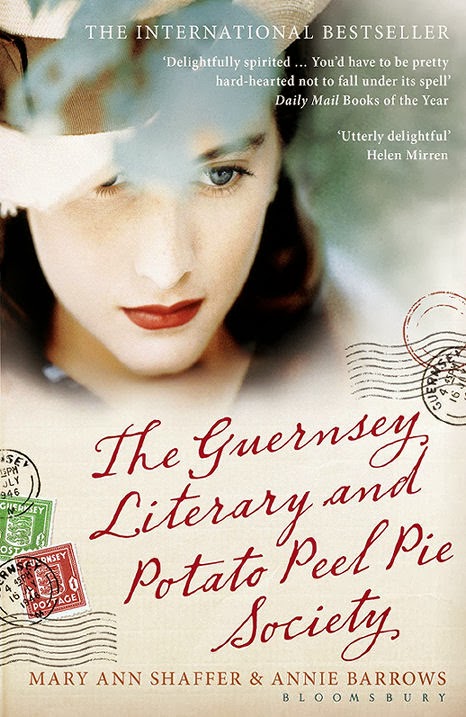
The Guernsey Literary and Potato Peel Pie Society - by Mary Ann Shaffer, Annie Barrows


REVIEW
The more I read about the Second World War, the more I am so thankful that it was over and can only hope and pray it will never be repeated anywhere ever again on that scale! I never liked watching war movies, neither reading the graphic detail, still don't, since the cruelty, suffering, hardships and horror are way too much to handle for me personally. So many millions of books were written about it that the actual message gets lost in the apathy resulting from too much information over a too long period of time. But then I come across a an epistolary novel such as The Guernsey Literary and Potato Peel Pie Society and I am once again mesmerized by the immensity of the human spirit, the need to survive, and the determination to succeed under appalling circumstances after the devastating war.

The letters between Juliet Ashton and the members of the society got me hooked to the book since the first "Dear Sidney" flowed from the pages. First off, it was like being invited into someone's personal space, mind, life, by being able to read their personal letters.

Secondly, the story is based on old fashioned paper letters which do not hail the same excitement or even are in fashion anymore in our modern world and the reader is immediately drawn into the nostalgia of a romantic art that disappeared almost completely.

The charm, as well as magic of the book being written in a constant flow of letters keeps the reader mesmerized. The characters introduce themselves through their own thoughts they shared with the writer in their letters to her. Juliet needed a fresh idea for her new book and accidentally receives a letter from the Guernsey island from a man who can hardly express himself verbally(she would later find out), yet writes detailed letters.

The Literary Society on the Guernsey island saved people's sanity in many ways during the German occupation when Elizabeth, the island's own earth angel(in modern terms she would be described as a people's pleaser) lied the society into existence. The society, which was afterwards forced to become functional, was like a key opening up the people's slumbering personalities when unlikely people were forced to read books, never realizing what an effect it would have on each person's life.

Another thought which struck me while reading how the islanders were forced by hunger and dire circumstances to burn their own wooden furniture, beloved books, even the banisters in their homes to survive the Occupation, was how the effect on the world is slowly repeating itself with the deforestation of the planet and what an effect it will ultimately have on people's lives. If there is one message I would like to take from the book it will be to plant more trees. I have not planted enough! It will also be in honor of those people who suffered severely in the wars of the world. Where there is war, nature is paying a dire price. Where there is peace the trees start growing again and the flowers come back. Earth heals itself like the human spirit gets healed by time.

The wit in the book is refreshing, the drama exhilarating and the narrative finishes off every issue. Compared to other war novels, it is a kind of 'light' read, but not too cheesy to be just another romantic novel for the light-brained. It has some meat to the story.

The fictional characters are ordinary human beings, even the male hero is an ordinary quiet man. It's based on real-life characters in real-life circumstances - people we all recognize as our families, friends and neighbors - no frills no fuzz, no fantasy or unrealistic heroes.

The book includes love, romance and everything needed to keep female readers(especially) interested, but surprisingly does not need to fall into the sex trap to make it acceptable to prospective buyers. The story itself is strong enough to guarantee the best seller status and deserves it. I give it four stars for excellent research, the delightful wit, as well as the dignity and respect it shows towards the more intelligent readers. If it was only a romantic novel, I would have dropped it after page three, but I finished it and loved every moment. It was worth it.

______________________________________________________________________________

AMAZON BOOK BLURB
It's 1946 and Juliet Ashton can't think what to write next. Out of the blue, she receives a letter from Dawsey Adams of Guernsey - by chance, he's acquired a book that once belonged to her - and, spurred on by their mutual love of reading, they begin a correspondence. When Dawsey reveals that he is a member of the Guernsey Literary and Potato Peel Pie Society, her curiosity is piqued and it's not long before she begins to hear from other members. As letters fly back and forth with stories of life in Guernsey under German Occupation, Juliet soon realizes that the society is every bit as extraordinary as its name.
______________________________________________________________________________

ABOUT THE AUTHORS
Anne Shaffer
Mary Ann Shaffer worked as an editor, a librarian, and in bookshops. Her life-long dream was to someday write her own book and publish it. The Guernsey Literary and Potato Peel Pie Society was her first novel. Unfortunately, she became very ill with cancer and so she asked her niece, Annie Barrows, the author of the children’s series Ivy and Bean, as well as The Magic Half, to help her finish the book. Mary Ann Shaffer died in February 2008, a few months before her first novel was published.


Annie Barrows is the enormously talented author of many acclaimed books including he Ivy + Bean series, The Magic Half, and the Guernsey Literary & Potato Peel Pie Society. She has also written non-fiction books under the pen name Ann Fiery. Annie’s latest book in the Ivy + Bean series is No News Is Good News. She worked for years as an editor until she decided to write children’s books like the ones she loved growing up. Her dedicated fans are eternally grateful she decided to pursue her dream. (Information source)


______________________________________________________________________________
ABOUT THE BOOK

Genres: Historical fiction, Second World World, Island Guernsey, Drama, Community, Romance, Suspense
Formats: Hardcover, Paperback, Mass Market Paperback, Kindle, Nook, Audio, CD, Audiobook,
Number of Pages: 257
Publishing date: May 10, 2009
Edition Language: English
ISBN: 0747596689
ASIN: B002R88G4U
Purchase links:  Amazon, Amazon UK, Barnes& Noble

______________________________________________________________________________

Friday, November 1, 2013

Nutmeg by Maria Goodin


Genre
: Mystery,  Suspense, Fantasy, Satire, Drama, Relationships, Mother-Daughter relationships, Community, England, British author

Formats: Paperback, Kindle, Nook
Publishers: Legend Press 
Published date: March 13, 2012
ASIN: B007JVNOCE
Pages:304
Edition language: English

Original Title: Nutmeg
US Title: From the Kitchen of Half Truths
Australian Title: The Storyteller's Daughter
Purchase linksAmazon,    Barnes & Noble


*****************

US edition - kindle: From the Kitchen of Half Truths ; Nook edition


Amazon Book Blurb:
Meg is growing up in a world of food filled fantasy; where her first tooth was so sharp her mother used her as a can opener, and eating too many apples once left her spitting pips. Then, age five, she is humiliated in front of the other children at school and turns her back on the world of fiction, deciding to let logic rule her everyday thoughts and deeds.

Years later, Meg's mother falls ill, and as she struggles to deal with the situation in an orderly fashion, her mother remains cocooned in her obsession with cookery, refusing to face up to her illness.

Slowly, Meg uncovers the truth about her childhood and is now faced with a humbling decision: to live in a cold harsh reality, or envelop herself in a wonderful world of make-believe.

Maybe life isn't defined as fact or fiction perhaps it can include truth, lies, and everything in between.


REVIEW:


I loved the beginning of the book:

" I came out a little underdone. Five more minutes and I would have been as big as the other children, my mother said. She blamed my pale complexion on her cravings for white bread (too much flour) and asked the doctor if I would have risen better had she done more exercise (too little air). The doctor wasn’t sure about this, but he was very concerned about the size of my feet. He suggested that next time my mother was pregnant she should try standing on her head or spinning in circles (spinning in circles on her head would be ideal) as this would aid the mixing process and result in a better proportioned baby."

Meg's mom had an obsession with food which lead to the most outrageously funny fantasies about her daughter's first five years on this planet. At first I laughed, because the stories were so unbelievably creative and funny. I would not have minded to have a mother with an imagination like that all.

But truth be told, I was seldom so touched by a book that I sat with a mouth full of teeth, not knowing what to say in reviewing a book. If I blurted out 'magnificent', I still would have to explain why, in which case it will become necessary to quote this entire book in the review!

A 21-year old girl, Meg May, arrives home after earning a degree in science. She is coming home to take care of her dying mother. It is soon clear that mom's outrageous fibs and fiction hid a mystery about Meg's childhood that she was unable or unwilling to reveal to Meg. 

"Throughout her pregnancy my mother suffered all manner of complications. She was overcome by hot flushes several times a day which the midwife blamed on a faulty thermostat, and experienced such bad gas that a man from the local gas board had to come and give her a ten-point safety check. Her fingers swelled up like sausages so that every time she walked down the street the local dogs would chase her, snapping at her hands. She consumed a copious amount of eggs, not because she craved them, but because she was convinced the glaze would give me a nice golden glow. Instead, when the midwife slapped me on the back I clucked like a chicken."

As a young girl, the world of fairies and talking animals only brought rejection from Meg's school friends, which left her lonely and growing up fending for herself in the harsh world of school and mean neighborhood kids. Now, as a grown-up scientist, she wants her mother to finally face reality and tell the truth and stop dodging her own story. Meg is convinced that people who believed in fiction and fantasy were gradually rotting their brains. Their fictional world was destroying them day by day, like a maggot eating away at their brains. Life has taught her that science is the only way to address the world and it's challenges. Science is her way of addressing life. It is the social home where she finally is accepted and respected.

The gardener, Ewan, appears out of nowhere, starts talking to the trees, asks the frogs nicely to leave the garden and explains to snails why they are not welcome. Valerie, Meg's mom, finds a soulmate, which drives Meg to more antagonistic behaviour. But Meg has a few lessons to learn, of which the first one is that Ewan might sometimes have his head in the clouds, but his feet are firmly on the ground.

When Meg finally discovers the truth behind her mom's fantasy world, she is devastated. As she meanders back into her mom's past, she slowly begins the walk on the road of healing and understanding. Forgiveness comes slowly and quietly. 

It is the second mother-and-daughter book I read this year that had me in tears. First of longing and sadness, and then of joy. The biggest compliment a daughter can give her mother is to finally be able to say to her: " I am everything you ever taught me, even when you thought I wasn’t listening." 

My mom never had to tell me fairy tales like this. She did not have to rewrite my history for me like Meg's mom. This book shocked and shook me to my deepest core. This book is so multifaceted it is very hard to write a complete review on it without turning it into a dissertation! Apart from the delightful fibs and fantasy in the book, it also addresses a magnitude of emotions, perceptions, approaches and -isms that can enhance or destroy lives, depending on how we apply it to our own life stories. 

I recommend it to all mothers and daughters alike; to fathers and brothers who always wanted to know what the real magic in fairy tales is all about. 

I wanted to rate it five stars for excellent writing, originality and plot, but if it was possible, I would have added another five stars for the unbelievable emotional journey it invites the reader on. Nobody will walk away unscathed from this experience.


ABOUT THE AUTHOR:


Maria Goodin was born in the South-East of England. Her first novel, 'Nutmeg', was published in the UK in 2012, and was based on an award-winning short story of the same title. The novel was published later that year in Australia under the title of 'The Storyteller's Daughter', and is soon due to be released in the US under the title 'From the Kitchen of Half Truth'. Book deals have also been secured in Italy, Germany, Spain and Sweden. Following a varied career which included administration, teaching and massage therapy, Maria trained to be a counsellor, and her novel was inspired by her interest in psychological defences. She lives and writes in Hertfordshire.

Monday, October 14, 2013

The Ghosts of Eden by Andrew J.H. Sharp


Genres: Africa, Uganda, historical fiction, family, community, drama
Formats: Paperback(384 pages), Kindle, Nook, Ebook
Published date:  May 21st 2009
Publishers: Picnic Publishing Ltd, Troubador Publishing Ltd, 
Original title: The Ghosts of Eden
ISBN 0955861330 (ISBN13: 9780955861338)
Edition language: English
Literary awards: Waverton Good Read Award (2010), International Rubery Book Award Nominee (2011)
Purchase links: Amazon, Barnes & Noble, Kalahari


Amazon book blurb: 
Winner of the 2010 Waverton Good Read Award for the best first novel by a British author, and shortlisted for the 2011 International Rubery Book Award, The Ghosts of Eden is a compelling story of loss, infatuation and atonement.

'I found I had accidentally ordered a masterpiece.'
Andrew Crofts

Zachye, tending cattle in the grasslands of East Africa, and Michael, son of missionaries, are happy in their childhood idyll. But the world is changing, propelling them towards tragedy. Haunted by guilt and grief they grow up severed from their heritage. When they both fall in love with the same beautiful woman, they must each face their past and hear their ancestors, if they are to be the one to win her...


In lyrical prose Andrew JH Sharp immerses the reader in a world where ancient ways of life and belief are being overwhelmed by the new. Neither a bandit-soldier in the remnants of Idi Amin's army nor a restless and detached surgeon can escape the memory of innocent boyhood. An intriguing cast of nomads, missionaries, expatriates and Indian traders share a landscape haunted by ancestral ghosts. The reader is drawn to a moving denouement where love and mortality are confronted.

REVIEW: 
Three young boys, three adult men: a story of kinship, hardship and bonding.


No man can know where he is going unless he knows exactly where he has been and exactly how he arrived at his present place -  Maya Angelou


Michael Lacey is a successful British surgeon. He is returning to Africa to deliver a lecture at the twelfth conference of the Lake Regions Surgical Association in Uganda after leaving the country as a young boy with no inclination of ever returning.

Yet, here he was, many years later, approaching his destiny and history with an indifference and arrogance he thought might protect him. His childhood memories floods back in astonishing detail. He meets Felice, a woman who becomes the bearer of all the supressed truths and wisdoms he never wanted to consider ever again, demonstrating the power of love and kinship he refused to acknowledge.


For the first time he trusts someone enough to share his story. But it would not happen as he planned and his eventual confrontation, with himself, will happen in a place he never thought he would become part of, yet, is inevitably destined for. Mother Africa did not forget him. He was just not interested, nor prepared, to accept it until he finally had to confront his old wounds which he, as a perfectionist and surgeon, could not heal himself. It would all be triggered when he had to save a life and was confronted by who he thought he was, and who he really was.

This is the story of three boys. Between them, they represent the multiculturalism of Uganda. Michael the protagonist, was an English missionary child. As a young boy in Africa he was emotionally ripped apart by two major tragedies. The events would lead to a long line of broken relationships, a loss of his faith and innocence and an emotional sterilized state in which he felt safe.

Michael’s talent for memorizing text came in handy when he had to attend a party – a trick to compensate for his lack of small talk. He could recite long passages from ‘The Rime of the Ancient Mariner’, Gray’s Anatomy, even the three chapters of the prophet Habakkuk or some other obscure part of the Bible. He wondered whether his gift was innate, or whether – a dark thought rising again – it was acquired through having to learn memory verses at his religious school.

There were the two brothers, Stanley and Zachye Katura of the Bahima tribe, growing up attending their father's cattle, learning to believe and respect the traditions of their ancestors as it was passed down from one generation to the next for thousands of years. But changes were coming: Stanley, the smaller and weaker brother, was to be sent to school, while Zachye must stay behind to tend their fathers wealth, his cattle. There was initially only enough money to send one of them into the British educational system offered in the local schools. But Zachye, as the oldest, insisted in going as well in competition with his brother.

The three boys would meet twice: as young boys, and again as adults. The first incident would shape their future through the choices made on their behalf by the adults in their lives.

The second would finally define them as adults through their own choices in dealing with their pasts.

It’s a grand opera in Africa and anyone can be big on our stage – although,’ his tone darkened, ‘we have to accept that, as in opera, high drama is the norm.’

This is one of those narratives that invites the reader into an Africa that is not sold with much fanfare, nor elaborate pomp and ceremony. The story enfolds the richness of souls and minds superseding all the hype presented to the world. It explains and celebrates the heart of a continent in its diversity and richness instead. It explains why the people of Africa have no equal anywhere in the world; why everyone who ever touches her soil, never want to leave again and if they do, often do so heartbroken...

The book brings a warmth and compassion for all the characters, good and bad. It explores the different meanings of happiness and love. It is one of those books about Africa that establishes a respect for the continent and her people, their values and history, without boring or losing the reader in the well-executed narrative. It is a blend of Alexandra Fuller's memoirs and that of Abraham Verghese, with a touch of Alexander McCall Smith added for good measure. Africa as Eden is confirmed, through the beautiful prose, for those who love her and for others who want to find her gentle soul. This is clearly not a book written by an outsider. This story comes from within and it shows.


ABOUT THE AUTHOR:


Andrew Sharp's first novel, The Ghosts of Eden, won the 2010 Waverton Good Read Award and was shortlisted for the 2011 International Rubery Book Award.

Andrew was brought up in East Africa and has worked in Uganda, Zambia and Zimbabwe - where his second novel, Fortunate, is set. He is based in the East Midlands in the UK where he combines his medical work with writing.


Enhanced by Zemanta

Tuesday, October 1, 2013

One Night in Winter by Simon Sebag Montefiore

Genres: Historical fiction, Russian history, murder, mystery, community, family relationships
Formats: Hardcover(480 pages)(Barnes & Noble) Kindle(Amazon)
Published date: September 5th, 2013(UK), May 2014 (USA) by Century
ISBN 1780891083 (ISBN13: 9781780891088) 
Edition language: English
Purchase links: Amazon Barnes & Noble Amazon UK 

REVIEW 
1945. Moscow, Russia. Jubilance raged over the war-ravaged city. Hitler was defeated. New beginnings lay ahead for a nation with promises of greatness by Stalin. The hope for normalcy raised slowly from the ashes.
The young Andrei Kurbsky saw “crumbling buildings, their façades peppered with shrapnel, windows shattered, roads pockmarked with bomb craters. Everything – the walls, the houses, the cars – everything except the scarlet banners was drab, beige, peeling, khaki, grey. But faces of the passersby were rosy as if victory and sunlight almost made up for the lack of food, and the streets were crowded with pretty girls in skimpy dresses, soldiers, sailors and officers in white summer uniforms. Studebaker trucks, Willys jeeps and the Buicks of officials rumbled by – but there were also carriages pulled by horses, carts heaped with hay or bedding or turnips, right in the middle of this spired city with its gold domes. Sometimes, when he closed his eyes in the heat and the world went a soft orange, Andrei heard laughter and singing and he was sure he could hear the city itself healing in the sunshine.” ` Life was starting over for everyone. The top officials in the Communist party were compensated with lavish lifestyle in the high-ceilinged apartments in the Granvosky building (otherwise known as the Fifth House of the Soviets), with dazzling corridors of capacious parquet floors and crystal chandeliers. Each official owned more than one chauffeur-driven car: open-topped Mercedes and -Packards, Dodge, Cadillacs, limousines, and Rolls Royces. It was also the home of Serafima Romashkina.
A new life was also starting for Andrei and his mother who just returned from exile in Stalinabad, “The Paris of Central Asia”, also known as “The Athens of Turkestan”. Everybody knew what that meant. “It was his tainted biography all over again.” Young, poor, optimistic, ambitious, inexperienced Andrei would meet Serafima.
It is a magnificent book: well written, extremely detailed, beautiful prose, spell-binding with no unfinished characters. The story is about a group of children and their families, every member, their teachers, and what happened to them, during the reign of Stalin. There were many love stories, too many, to be told. A historical novel at its best.

ABOUT THE AUTHOR 
Simon Sebag Montefiore is the author of the prize winning books Jerusalem: the Biography' and Young Stalin and the novels Sashenka and now One Night in Winter. His books are published in over 40 languages and are worldwide bestsellers. He read history at Gonville and Caius College, Cambridge University, where he received his Doctorate of Philosophy (PhD).
The novel One Night in Winter is out now in the UK (5 September 2013) and in the USA in May 2014.